Red
640 nm
The widest dose range on the unit, up to 186 J/cm². It is the light the Peptide Gel Mask runs under in GENOSYS protocols.
- 42 mW/cm²
- Irradiance
- 28 J/cm²
- Standard dose
- 5-60 min
- Time

GENOSYS
Loading...
GENO-LED IR II · Professional LED device
Five wavelengths, and the numbers behind each one.
A dome LED unit for the treatment room: 1,710 diodes across red, blue, green, yellow and infrared. Every mode is published with its irradiance and its standard dose, so a session is planned before it starts instead of guessed at.
1,710
LEDs: 380 of each colour, 190 infrared
5
Wavelengths, 423 to 830 nm
70 W
Rated electrical power
2.6 kg
The whole unit
The five modes
Five channels in one dome instead of a single red panel. Each has its own irradiance, its own standard dose and its own range, and you can read all of it before the session starts.
640 nm
The widest dose range on the unit, up to 186 J/cm². It is the light the Peptide Gel Mask runs under in GENOSYS protocols.
423 nm
The highest irradiance on the unit, 46 mW/cm². In GENOSYS sequences it follows the SRS peel.
532 nm
A soft channel: 15 mW/cm² and a standard dose of 9 J/cm². It runs on its own or alternating with red.
583 nm
The softest channel on the unit: 11 mW/cm² and 7 J/cm². It also alternates with red every three seconds.
830 nm
Runs under any colour, at the same time as it, on its own shorter clock.
Infrared runs on its own clock: 1 to 10 minutes, against 5 to 60 for the visible colours.
The specification most listings leave out
Output intensity in milliwatts per square centimetre, standard dose in joules per square centimetre, and the range the unit can reach. With these two numbers a light device is dosed, not just switched on.
Bandwidth is 20 ±5 nm on every mode. 70 W is the rated electrical power of the unit.
| Mode | Irradiance | Standard dose | Time | Dose range |
|---|---|---|---|---|
| Red 640 | 42 mW/cm² | 28 J/cm² | 5-60 min | 1-186 J/cm² |
| Blue 423 | 46 mW/cm² | 28 J/cm² | 5-60 min | 1-152 J/cm² |
| Green 532 | 15 mW/cm² | 9 J/cm² | 5-60 min | 1-52 J/cm² |
| Yellow 583 | 11 mW/cm² | 7 J/cm² | 5-60 min | 1-39 J/cm² |
| Infrared 830 | 15 mW/cm² | 12 J/cm² | 1-10 min | 1-56 J/cm² |
Running two at once
Two different behaviours, and the difference matters when you are writing a protocol.
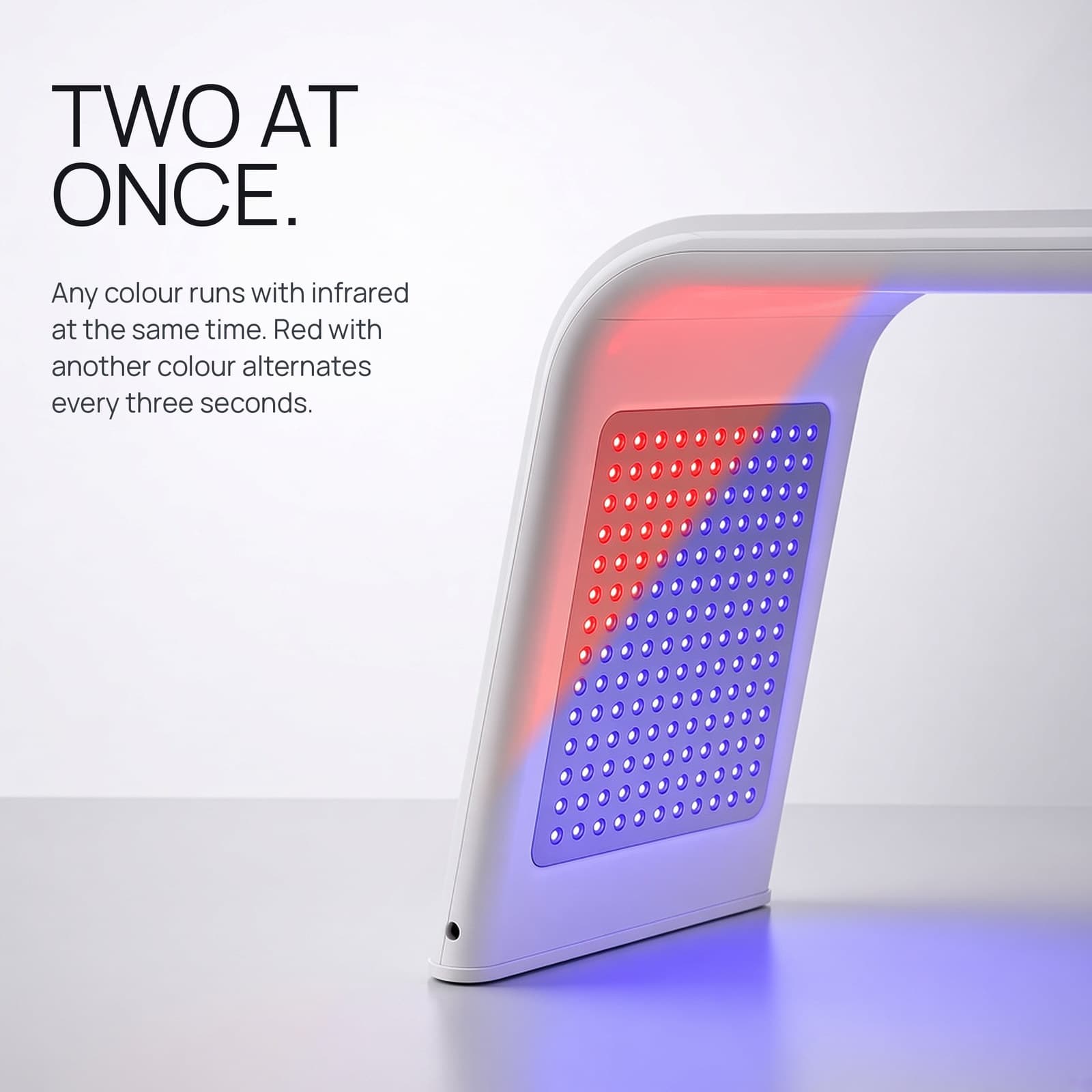
Red, blue, green or yellow runs simultaneously with 830 nm: both lights stay on for the whole session.
Red with blue, green or yellow swaps between the two every three seconds. It is an alternation, not a pulsed mode, so each colour is on for about half the clock.
The unit
IR II replaces GENO-LED IR with more LEDs, more power and a bigger dome.
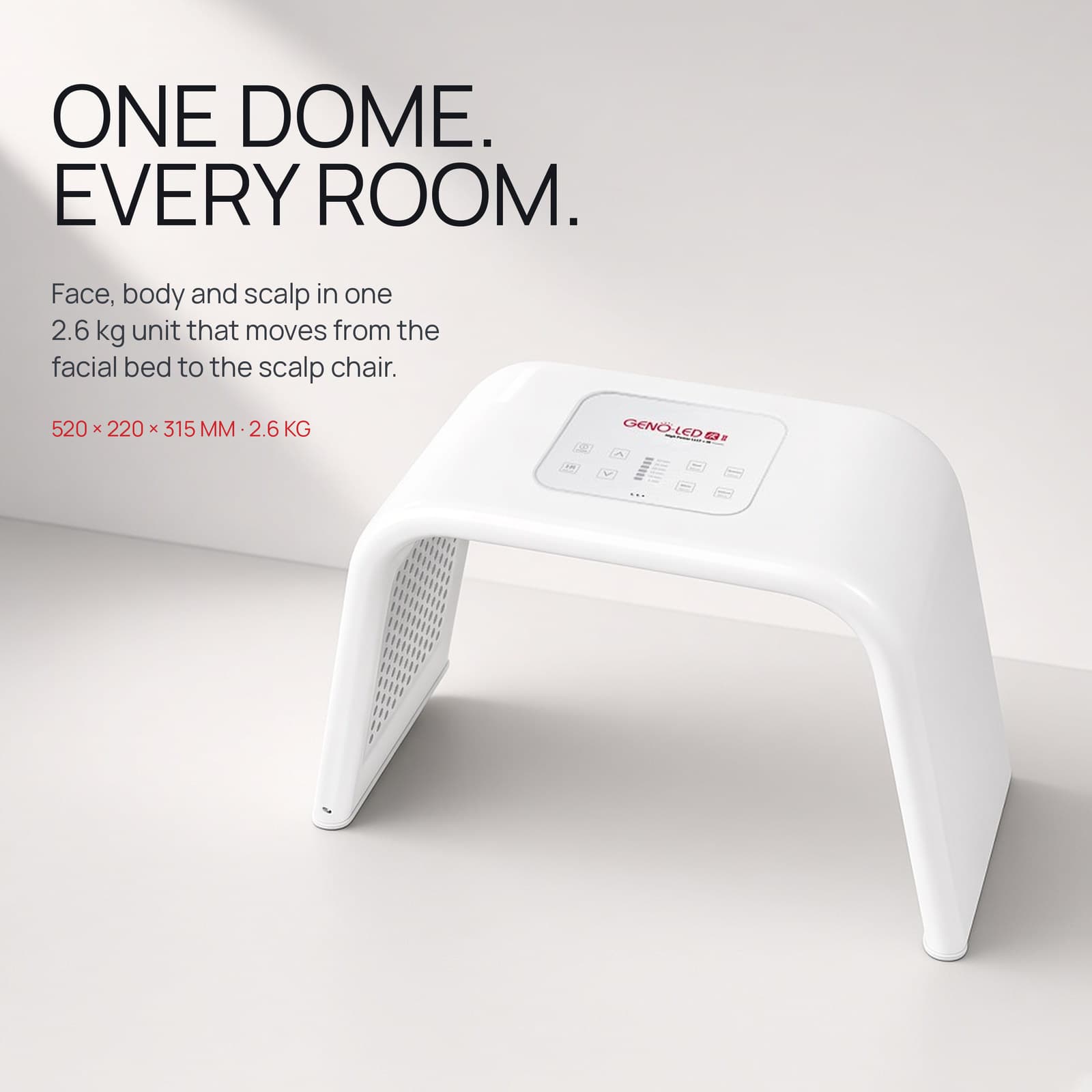
380 each of red, blue, green and yellow, plus 190 infrared.
The rated electrical power of the new generation.
520 × 220 × 315 mm against 380 × 220 × 280 mm on GENO-LED IR, at 2.6 kg.
423, 532, 583, 640 and 830 nm in one unit.
In the treatment room
The GENOSYS brochure shows the device inside finished sequences, and every one of them is built on products from our catalogue.
The brochure carries ten cases from the practice of Dr Marija Boscovic, each captioned with the protocol used. The interval after injections, a thread lift, microneedling or a peel is set by the specialist.
The products in those sequences, all in stock.
In the literature
A team at the University of Rome Tor Vergata used GENO-LED as the light step in a published androgenetic-alopecia study, alongside platelet-rich plasma and follicle stem-cell micrografts.
Gentile et al., Platelet-Rich Plasma and Micrografts Enriched with Autologous Human Follicle Mesenchymal Stem Cells Improve Hair Re-Growth in Androgenetic Alopecia. Biomedicines 2019, 7(2), 27.
In that protocol the light was an adjunct to the injections. The study ran in 2019 on the previous-generation unit: IR II launched in 2024.
All five lights, a session under the dome and the unit in the room.
Running a session
There is a power socket on either side. The power button lights up and the unit goes to standby.
Touch Power ON/OFF and set the timer with the up and down keys, in five-minute steps.
One touch for red, blue, green or yellow. Add IR to run with it at the same time, or a second colour to alternate with red.
A voice message plays a minute before the end, then the unit switches itself off. Prompts in English, Korean or Chinese.
Before the first session
Questions about documents, contents or delivery: message us and we will arrange it.
The details
Questions
More light and a bigger dome: 1,710 LEDs against 1,145, 70 W against 60, and 520 × 220 × 315 mm against 380 × 220 × 280 mm. The same five wavelengths: 423, 532, 583, 640 and 830 nm.
Standard dose is 28 J/cm² on red and blue, 9 on green, 7 on yellow and 12 on infrared. The full table with irradiance and dose ranges is above.
The panel timer runs from 5 to 30 minutes in 5-minute steps. The dose table gives 5 to 60 minutes for the visible colours and 1 to 10 for infrared, and the manual for your unit sets the exact exposure for your protocol.
Yes, in two ways. Any colour runs at the same time as infrared, and red alternates with blue, green or yellow every three seconds.
No, it is the rated electrical power of the unit. For dosing, what matters is the irradiance and dose in the table.
We deliver across the UAE from our own stock in Dubai. Message us before you buy: we will confirm the contents and send the documents for your unit.
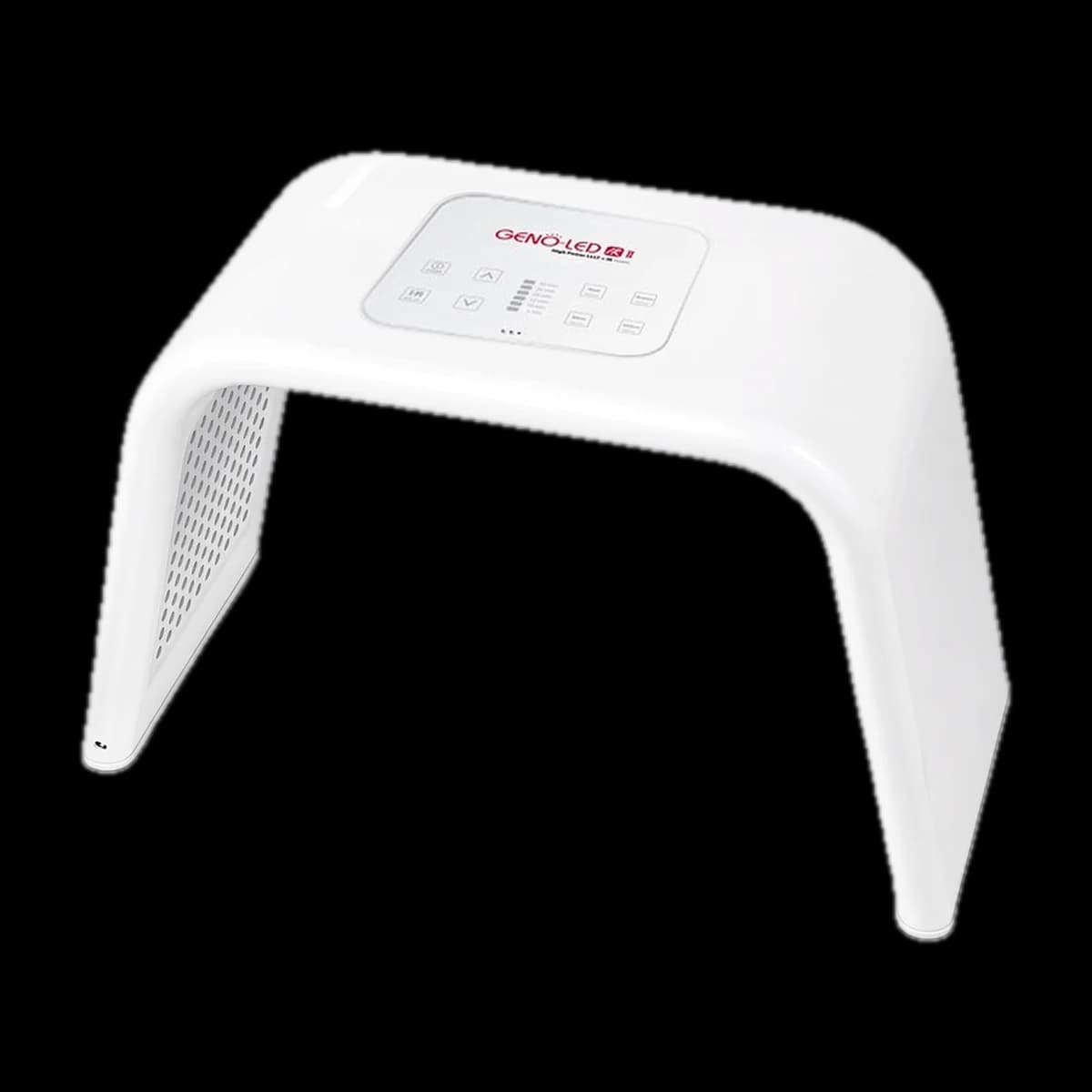
Five wavelengths, and the numbers behind each one.
GENO-LED IR II
Delivered across the UAE · Dispatched from Dubai


